Quick answer
A soft goods feasibility phase should deliver a defined problem, a comparison of plausible design approaches, evidence addressing the most important technical uncertainties, and a recommendation for what happens next. Depending on the scope, that evidence may include material trials, construction samples, or functional mock-ups. The outcome is a justified decision to proceed, revise, investigate further, or pause—not an automatic promise of production readiness.
A founder may arrive with a detailed brief, an attractive rendering, or a handmade prototype. A hardware team may already have working electronics and need to figure out how the product attaches to the body. In each case, the next investment depends on questions that remain unanswered.
Will the product stay in position? Can the user put it on without assistance? Can a removable cover be taken off without dismantling the device? Can the proposed construction be sampled using a realistic manufacturing process?
A feasibility phase gives those questions a defined place in the development process. Its value comes from making the next commitment better informed.
1. A clear problem statement and practical success criteria
The first deliverable should establish what the product needs to accomplish, for whom, and under what conditions.
“Comfortable,” “premium,” and “easy to manufacture” describe intentions. They need enough definition to guide a comparison between possible solutions.
For a body-worn product, that might mean identifying the intended fit range, how long it will be worn, the movements it must accommodate, and the mass of the components it carries. For a protective equipment case, it might mean defining the contents, access needs, carrying load, and expected handling conditions.
This does not require pretending every specification is already known. It means separating requirements from assumptions and preferences.
The brief should identify:
- The intended user and use environment.
- The essential function and constraints that cannot change.
- The variables the team is free to explore.
- The evidence needed to judge the next development step.
- The questions explicitly outside the phase’s scope.
Agree on success criteria before reviewing results. Otherwise, it is too easy to call an attractive concept successful without knowing whether it solves the original problem.
2. A comparison of credible product architectures
Soft goods architecture describes how textiles, padding, supports, closures, and hardware work together.
The proposed solution should be examined rather than accepted simply because it appears in the initial brief. A wearable might use a sleeve, a strap system, or a shaped textile panel. A padded product might depend on foam geometry, tension in its cover, or an internal support. Each approach creates different trade-offs.
A useful feasibility phase compares a manageable number of genuinely different approaches. The number should follow the problem and agreed scope, rather than an arbitrary promise of three concepts.
Annotated sketches, simple models, or cross-sections can explain where loads travel, how components attach, how the user accesses them, and which parts need to move independently.
The deliverable should make the recommended direction understandable—and explain why other approaches were set aside.
For products combining rigid and flexible components, this connects directly to soft goods and hardware integration.
3. Evidence addressing the highest-priority uncertainties
A feasibility phase needs an evidence plan. Some questions can initially be addressed through existing component information, supplier discussions, or construction review. Questions about fit, movement, and material behavior often need physical investigation.
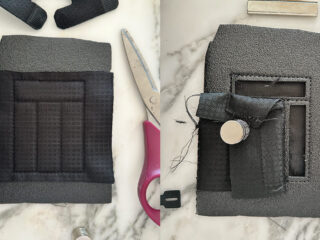
The scope might include a rough fit mock-up, a seam sample, a foam-and-cover assembly, or an attachment trial using a representative component weight. These are focused experiments; they do not always require a complete product.
For example, a simple textile carrier with a weighted dummy component may help compare attachment positions. It would not establish that the final electronic product is safe, durable, or ready for production.
Each investigation should record:
- The question being examined.
- The sample, materials, and setup used.
- The conditions and observations.
- The limitations of the result.
- The decision or next investigation it supports.
An assessment based only on drawings can still identify useful issues. It should be labeled as a preliminary assessment, with physical questions left open. The strength of the conclusion must match the strength of the evidence.
4. An initial material and construction direction
A feasibility phase should identify plausible material families and construction methods, together with the reasons for considering them.
That might include comparing stretch and non-stretch textiles, investigating whether a foam needs additional support, or considering sewn versus bonded construction. The purpose is to understand the implications for the product, not to lock every fabric and trim before testing.
Material behavior also depends on the assembly. A fabric that feels soft as a swatch may behave differently when tensioned over foam or sewn into a curved panel. A closure that is easy to operate loose on a table may become awkward once attached to a flexible surface.
Useful documentation identifies the candidate materials, construction assumptions, samples examined, and further checks needed. Substitutions in an early mock-up should be recorded so the team knows which conclusions require another test with representative materials.
5. A preliminary view of manufacturing constraints
Technical feasibility and repeatable manufacturing are connected, but they are different questions.
A one-off sample may involve hand adjustments that would be difficult to reproduce consistently. A proposed construction may require equipment or supplier capabilities that are not available at the intended production scale.
Early manufacturing review should investigate the constraints most likely to change the design: assembly access, layer thickness, reinforcement placement, process compatibility, component availability, and material minimums.
Where supplier input is part of the scope, record what was actually confirmed. A supplier’s willingness to attempt a sample is not proof that the construction will meet the requirements.
At this stage, cost guidance should identify assumptions and likely cost drivers. A firm unit price may need a more developed design, specified materials, quantities, and supplier quotations. The phase should not manufacture certainty where that information is missing.
6. A record of what remains unresolved
The final review should clearly separate findings from open questions.
A simple table can keep the discussion practical:
| Question | Evidence collected | Current conclusion | Next action |
|---|---|---|---|
| Does the assembly remain in position? | Movement observations with an early mock-up | Promising under the conditions examined | Check the intended fit range and longer use |
| Can the cover be removed? | Removal trial around a dummy housing | Access works, but the opening distorts | Refine and retest the opening |
| Can the proposed layers be joined? | Initial construction sample and supplier feedback | One combination appears workable | Test representative materials and required performance |
These are illustrative entries, not results from a studioFAR client project.
For products needing specialist engineering, performance testing, or regulatory evaluation, the phase should identify those dependencies and who needs to address them. Design feasibility alone does not establish medical efficacy, certification, or compliance.
7. A recommendation and a defined next phase
The closing deliverable should state whether the evidence supports proceeding, revising the direction, conducting another focused investigation, or pausing the project.
It should also identify the next scope, deliverables, responsibilities, dependencies, and planning assumptions. Development fees and third-party expenses should remain separate when outlining the investment ahead.
If the concept is ready for technical development, explain which decisions can now be documented. If a central question remains unresolved, explain what evidence is needed before committing to that work.
A complete tech pack is not automatically a feasibility deliverable. Preparing detailed manufacturing documentation around an untested assumption can create substantial rework. On the other hand, targeted drawings may be needed early to communicate a specific test or sample.
The level of documentation should serve the decision being made.
Example: a removable cover for a body-worn device
Consider a hypothetical device that needs a washable cover and a stable attachment to the wearer.
A useful first phase could compare two attachment arrangements, make a simple fit mock-up, and investigate whether the cover can be removed around a representative housing. It could also identify construction options and the information needed from the electronics team.
The result might support one arrangement while identifying unresolved questions about longer wear, repeated washing, and fit across users. Those findings would guide the next prototype and documentation scope.
A polished image would help communicate the direction, but the decision would depend on the evidence. That is why a beautiful rendering is not the same as a manufacturable product.
What to agree on before starting
Before commissioning feasibility work, agree on the questions, methods, physical samples if any, success criteria, exclusions, and final review format. Define what happens if the evidence is inconclusive.
The phase should be scoped around the uncertainty in the product. A familiar bag construction may need a focused development review. A new wearable attachment or unfamiliar material assembly may justify a more substantial investigation.
The useful outcome is knowing what you have learned, how much confidence to place in it, and what investment makes sense next.
Discuss your soft goods development challenge
studioFAR helps founders and product teams define soft goods architecture, investigate construction challenges, and plan development toward manufacturing. If your concept still has unresolved questions around fit, materials, attachments, or hardware integration, discuss your project with studioFAR to explore an appropriate starting scope.
Frequently asked questions
What is a soft goods feasibility phase?
It is a defined early development effort that investigates whether a proposed soft goods approach is practical under agreed requirements and constraints. It should produce findings, identify remaining uncertainties, and recommend the next development step.
Should a feasibility phase include a prototype?
It should include the physical investigations needed to answer its agreed questions. That might mean a material trial, partial assembly, or functional mock-up rather than a complete prototype. If physical investigation is excluded, conclusions about untested behavior should remain provisional.
Is feasibility the same as concept design?
Concept design explores possible solutions and communicates direction. Feasibility examines the assumptions that could prevent those solutions from working. The activities can overlap, but feasibility needs evidence and a reasoned recommendation as well as concepts.
Will I receive a production-ready tech pack?
Only if that deliverable is explicitly included and the design is sufficiently resolved. A feasibility phase more commonly provides preliminary architecture, investigation results, material and construction direction, and a scope for subsequent technical development.
How long should a feasibility phase take, and what should it cost?
The scope determines both. A document-based review differs substantially from work requiring material sourcing, mock-ups, supplier trials, and iteration. Ask for a defined scope, schedule, fee, and separate third-party allowances. A feasibility fee should not be mistaken for the cost of completing the full development program.
Can a feasibility phase conclude that a project should pause?
Yes. If a critical requirement cannot be met with the approaches investigated, or an essential dependency remains unresolved, pausing or revising the project may be the appropriate recommendation. That conclusion should explain the evidence and what would need to change before proceeding.