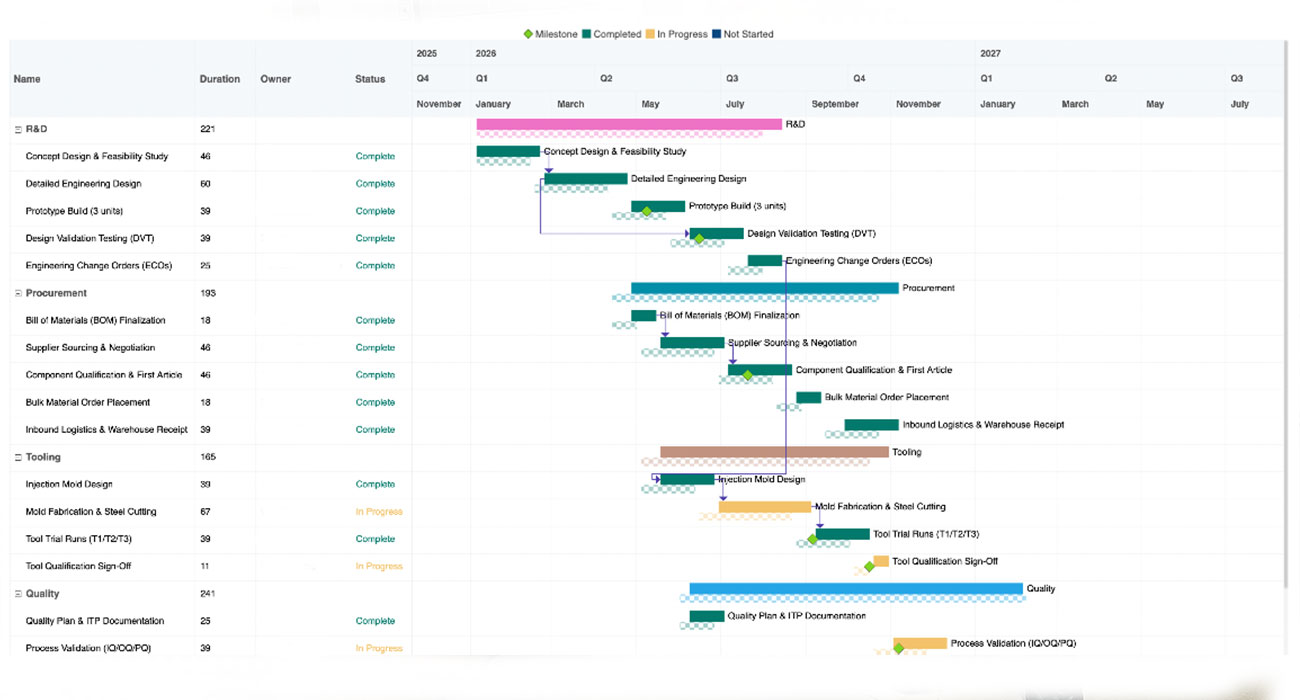
For a new soft goods product requiring design, technical documentation, and factory sample iterations, about four to six months is a useful initial planning allowance from project kickoff through a developed design and reviewed samples. This is a planning guide, not an industry average or a guaranteed completion date. Complex wearables, custom components, and unresolved performance questions can extend the schedule substantially. Production and inventory delivery require additional planning.
A focused revision to an established product may take less time. An unfamiliar construction that still needs feasibility work may require a longer investigation before a dependable full-program schedule can be proposed.
The most useful way to answer the timing question is to identify the milestone, the decisions still open, and the dependencies that control the next step.
First, define what “finished” means
“I need the product in three months” can mean several things.
A founder might need something to show an investor. A product team might need samples for a fit study. Another business might mean stock available to ship to customers.
Those outcomes are different:
| Milestone | What it provides |
|---|---|
| Concept direction | A proposed product arrangement, appearance, and functional approach. |
| Early functional prototype | A physical sample that investigates specific questions about use or construction. |
| Refined development sample | An updated assembly evaluated against agreed requirements, with remaining issues recorded. |
| Production approval | Acceptance of the required samples, specifications, and checks for the planned manufacturing process. |
| Delivered inventory | Manufactured goods that have passed agreed inspections and reached the intended destination. |
A development schedule should say which milestone it covers. Receiving a prototype does not automatically establish that the product is approved for production, and completing a tech pack does not mean a factory can immediately ship inventory.
What happens during development?
The work generally moves through product definition, design development, technical documentation, sampling, evaluation, and corrections. Some activities overlap, but others depend on earlier decisions.
At the beginning, the team defines the user, essential functions, constraints, and intended commercial scope. That information guides the product configuration and the material and construction approaches worth exploring.
Technical development turns the selected direction into instructions for sampling: drawings, dimensions, materials, components, and assembly details. Early physical investigations may happen before that package is complete, particularly when a key construction question needs an answer first.
Sampling then puts those decisions into a physical assembly. The team evaluates the result, agrees on corrections, updates the information, and decides what the next sample needs to demonstrate.
A useful timeline includes all of that work. It also accounts for material sourcing, sample-room availability, shipping, and client review.
An illustrative 21-week development schedule
The following is a hypothetical planning example for a moderately complex sewn product. It is not a fixed studioFAR package, a supplier quotation, or a claim that every product needs exactly two sample rounds.
It assumes one main product version, available materials and components, no new custom hardware tooling, an agreed start date, prompt consolidated feedback, and supplier availability. It includes two sample cycles and project-specific development checks. Independent certification, clinical validation, bulk production, and inventory freight are excluded.
| Calendar window | Work allowance | Main activity | Decision or output |
|---|---|---|---|
| Weeks 1–2 | 2 weeks | Product definition and initial technical review | Agree on objectives, constraints, and priority questions. |
| Weeks 3–5 | 3 weeks | Concept and construction development | Select the direction to develop for sampling. |
| Weeks 6–9 | 4 weeks | Technical package and supplier coordination | Release coordinated sample instructions and confirm inputs. |
| Weeks 10–14 | 5 weeks | First sample cycle | Source required sample materials, build, ship, review, and issue corrections. |
| Weeks 15–18 | 4 weeks | Revised sample cycle | Build, ship, and evaluate the updated assembly. |
| Weeks 19–21 | 3 weeks | Documentation and development review | Update specifications and record readiness or remaining work. |
This example totals 21 weeks—roughly five months. It illustrates how a multi-month schedule can arise even when the product contains no electronics or new molded components.
The final review is a decision point. If the samples do not meet the agreed requirements, the schedule needs another defined investigation or revision. The calendar does not make an unresolved design ready for manufacturing.
The table is a baseline rather than a contingency allowance. A project with significant unknowns needs additional time assigned to those risks, with dates reviewed as evidence becomes available.
Why sample rounds take more than sewing time
A sample cycle includes several connected activities:
- Confirming the current drawings, materials, and component information.
- Resolving supplier questions and obtaining the required inputs.
- Making or revising patterns and building the sample.
- Shipping or otherwise making the sample available for evaluation.
- Conducting the agreed review or user evaluation.
- Consolidating feedback and documenting the next revision.
The time spent at a sewing machine is only part of that cycle.
A sample may reveal that a closure is difficult to reach, a cover is awkward to remove, or a reinforcement creates an uncomfortable edge. Those findings need interpretation before the next build. Sending a new sample request without deciding what should change can create another round without resolving the original issue.
The number of rounds should follow the evidence. A familiar construction may converge quickly. A new interaction between fit, materials, and hardware may need several focused investigations before a complete sample is useful.
What changes the timeline most?
The actual starting point
An existing tech pack can save time if its decisions are usable and supported by relevant samples. If the drawings describe an untested construction, the underlying development may still need attention.
Similarly, a handmade prototype may prove an important function while leaving production methods unresolved. Review what the existing work demonstrates before reducing the schedule around it.
Technical uncertainty
A conventional pouch and a body-worn system with adjustable support do not carry the same development questions, even if their dimensions are similar.
When the central approach remains uncertain, an initial soft goods feasibility phase can help define the work that follows. The first reliable estimate may be for that phase, with later dates remaining provisional.
Materials and custom components
A material being listed in a catalog does not confirm that the required color, finish, or quantity is available for sampling. Custom trims or tooling introduce additional supplier work.
Confirm availability and lead times rather than placing unverified assumptions into the schedule. If substitute materials are used in an early sample, record which conclusions still need checking with the intended production materials.
Hardware and other engineering dependencies
A change to a housing, battery, frame, or attachment point can affect the surrounding textile design. Teams should identify which interfaces are stable and when the next revisions will be available.
Some soft goods development can proceed with representative components, but final fit and assembly checks need the appropriate hardware. Our guide to hard goods and soft goods integration explores why these decisions need coordination.
Fit range and product variations
Additional sizes, configurations, and material combinations create more work to document and evaluate. A successful sample in one size does not automatically resolve the others.
Agree on the versions included in the initial scope and which will follow later. Additions should trigger a schedule review rather than quietly expanding the original commitment.
Approvals and access to reviewers
If a sample waits for feedback, dependent work may pause. A delayed response can also affect the next available sample-room slot.
Identify who approves each milestone, when they can review it, and how conflicting comments will be resolved. Include access to intended users or specialist reviewers where their input is required.
How to shorten the schedule responsibly
The most practical opportunities often involve simplifying the work and preparing decisions early.
Start with one clearly defined product version. Use available materials and components when they meet the requirements. Give the team representative hardware, existing samples, and reference information at kickoff. Reserve review time rather than trying to find it after samples arrive.
Agree on what each sample should demonstrate, then provide one consolidated set of comments. Distinguish a necessary correction from a new feature or preference that changes the scope.
Some activities can run in parallel. Supplier capability reviews and material inquiries can begin while the design is being developed. However, dependent work should not be treated as independent simply to make a schedule look shorter. A cover pattern built around a changing housing may need substantial revision.
A smaller first milestone can also be useful. If the immediate need is to investigate a fit problem, commission that investigation explicitly. Do not describe the resulting mock-up as production-ready merely because it arrives sooner.
Development is only part of the launch calendar
After development, the manufacturing plan may still need production-material approval, final samples, tooling completion, purchase-order confirmation, material procurement, factory scheduling, assembly, inspection, packing, and freight.
Confirm those activities with the manufacturer and other responsible partners. Any independent testing or compliance work should have its own scope, provider, dependencies, and timing. Avoid assuming it can all be added after the launch date is announced.
Also separate the date a factory finishes goods from the date inventory is available for sale. Delivery and fulfillment preparation need their own allowances.
For budgeting across these stages, see How Much Should You Budget for Soft Goods Product Development?.
What to ask before accepting a timeline
A useful proposal should make the schedule understandable. Ask:
- What milestone does the estimated completion date cover?
- What information and approvals are required before the clock starts?
- Are sample sourcing, shipping, evaluation, and corrections included?
- Which supplier dates are confirmed, and which remain estimates?
- What happens if the first approach does not meet the requirements?
- What work is excluded, and who owns the dependencies?
Treat the timeline as a working plan with named responsibilities. Update it after major reviews, particularly when the design, sample findings, or supplier assumptions change.
Plan your development timeline with studioFAR
studioFAR helps founders, startups, and product teams develop technically challenging soft goods, wearables, and products that integrate textiles with hardware.
If you have a target date, share your project with studioFAR along with your current drawings or samples, available development investment, and the milestone you need to reach. A realistic starting scope comes from understanding what is already resolved and what still needs to be demonstrated.
Frequently asked questions
How long does it take to develop a soft goods product?
About four to six months is a useful initial allowance for a new product needing design, documentation, and sample iterations. It is not a universal benchmark or delivery promise. The actual estimate depends on scope, starting point, technical uncertainty, suppliers, and approvals; complex projects may take substantially longer.
Can I have a prototype within a few weeks?
A focused mock-up or limited revision may be possible when the inputs and sample-making capacity are available. Define what that sample needs to demonstrate. A short prototype schedule should not be assumed to include full development, validation, or production preparation.
How many prototype rounds should I plan for?
There is no universal number. Discuss an initial allowance and the questions each round will address, together with the process for approving additional work. The two rounds in this article's example are an assumption for that illustration, not a requirement or limit.
Does an existing tech pack make development faster?
It can if the specifications are current, coherent, and supported by useful physical work. A review may identify missing construction decisions or unresolved fit issues. The schedule should reflect what the package actually saves.
Does the development timeline include manufacturing and delivery?
Only if they are expressly included. Bulk materials, production scheduling, manufacturing, inspection, and freight commonly require a separate plan. Confirm whether the quoted milestone is a design, a sample, production approval, or inventory at your destination.
What if I have a fixed launch date?
Work backward from the required inventory date using confirmed supplier and logistics inputs, then assess whether the remaining development time is realistic. If it is not, consider reducing the first release's scope or changing the date. A presentation sample may support an earlier milestone without making the full product ready to ship.