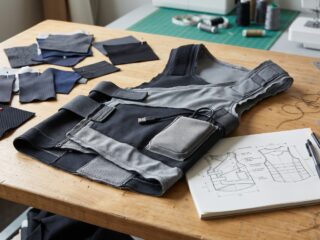
Yes. An existing soft goods tech pack can often be improved without restarting the entire project. The first step is to identify which decisions are supported by samples or other evidence, which details need clearer documentation, and which parts of the product still need development. Keep the useful work and define the gaps before revising the drawings.
A founder may arrive with a detailed PDF, a set of technical illustrations, and a sample that is almost right. They have already invested in the product. Understandably, they want to know whether a new development partner can build on that investment.
The answer depends less on the number of pages than on what those pages establish.
A tech pack might communicate the exterior very clearly while leaving the internal construction open to interpretation. Another might describe a well-developed product accurately but need a few sections updated after sampling. Those are different scopes of work.
Start by defining what the next revision needs to accomplish
Before opening the drawing file, establish why the tech pack needs attention.
Is the factory asking questions it cannot answer from the document? Does the sample differ from the specification? Has the product changed since the last drawings were issued? Are you preparing to move to another manufacturer?
Each situation needs a different response. A missing material reference may require documentation and sourcing confirmation. A wearable that shifts during movement may need further fit and attachment development before anyone can specify a correction.
Also define the next milestone: a preliminary quotation, a focused construction sample, a complete prototype, or preparation for production. A document can be adequate for one purpose and incomplete for another.
Review the product and the documentation together
The useful starting point is a comparison between the current brief, the tech pack, the physical sample, and the factory’s feedback.
A drawing shows the intended construction. A sample shows one interpretation of it. Neither automatically proves that the intended product works or can be made consistently.
Consider a backpack pocket that is difficult to use. If the opening is smaller than the drawing specifies, the immediate question is why the sample differs. If the opening matches the drawing but the intended item still catches, the design itself needs attention. If different pages show different opening dimensions, the documentation needs to be reconciled first.
These distinctions prevent a revision from fixing the wrong problem.
A review should leave you with three clear groups:
- Retain: Details supported by the current requirements and relevant sample findings.
- Revise: Decisions that are sufficiently resolved but missing, contradictory, or unclear in the documentation.
- Investigate: Questions that need design work, sourcing input, or a physical trial before a final instruction can be issued.
This is more useful than describing the entire tech pack as either good or bad.
What can usually be retained?
Useful existing work may include the overall product concept, selected dimensions, pocket layout, approved branding, component references, and construction details that have been evaluated in the relevant assembly.
Retain those elements because they remain appropriate, not simply because they already appear in the file.
For example, a zipper specification may remain suitable while the surrounding opening needs to change. The exterior silhouette may be retained while the internal reinforcement is developed further. A material choice may be carried forward subject to confirming availability and its behavior in the revised construction.
Keeping a feature also means checking what connects to it. Moving a compartment can affect nearby seams, lining pieces, access, and assembly order. A change that occupies one drawing may require updates on several other pages.
Separate clarification from further development
Some revisions make an established decision easier to manufacture. Others require someone to make a decision that has not yet been resolved.
A documentation revision might include:
- Adding reference points and measurement conditions to a dimension.
- Resolving a mismatch between a drawing and the bill of materials.
- Identifying a selected buckle or zipper more precisely.
- Adding a section view of an established seam or layered assembly.
- Recording an approved sample change that never reached the master file.
Further development might include:
- Determining how a strap attachment should distribute load.
- Resolving how a shaped cover can be removed and reinstalled.
- Selecting a foam and fabric combination that works in the finished assembly.
- Reworking an opening that cannot accommodate the intended contents.
- Establishing a construction the intended manufacturer can repeat.
The second group may eventually produce drawing updates, but the work starts before drafting. This is why a polished document alone does not establish that a design is finished, as discussed in A Beautiful Rendering Is Not the Same as a Manufacturable Product.
Example: improving a backpack tech pack
Imagine a backpack with a clear exterior design and a sample whose main compartment accommodates the intended equipment. During review, three issues emerge: the top handle pulls the shell out of shape, a pocket is awkward to access, and the lining material is described differently on two pages.
This is an illustrative example, not a studioFAR client case.
The main compartment and exterior direction may be retained if they still meet the brief. The conflicting lining references can be resolved by confirming the intended material and updating every affected callout.
The handle needs investigation. The visible distortion could involve the attachment location, reinforcement, surrounding panels, or the specified materials. Adding a note that says “reinforce handle” would leave the central decision unresolved. A small assembly using representative materials can help evaluate a proposed construction before another complete bag is made.
The pocket needs a comparison between its specified opening, the actual sample, and the item the user must retrieve. That review determines whether the next instruction is a sewing correction, a dimensional revision, or a different access arrangement.
The resulting scope is specific: retain the established product direction, clarify the lining specification, develop the handle junction, and resolve the pocket access. The project can move forward without treating every page as unfinished.
Editable files help, but they do not replace evidence
An editable source file can make it easier to revise drawings, dimensions, and callouts consistently. A PDF can still be reviewed and annotated, but rebuilding portions of it may be necessary if the original drawing files are unavailable.
Ask for the latest editable files, linked assets, exported PDF, revision history, and any supporting specifications you are authorized to share. Identify which files actually produced the current sample.
Patterns are a separate consideration. A tech pack may communicate construction without containing the manufacturer’s production patterns. Confirm what patterns exist, who maintains them, and whether access or transfer has been agreed. Do not assume that receiving a tech pack includes every file needed to reproduce the product elsewhere.
It is possible to preserve the product design while rebuilding its documentation. That is different from starting the product development over, although it still requires time and careful checking.
Define a bounded revision scope
A useful revision proposal should state what will be reviewed, what can be carried forward, what needs additional development, and what the next deliverable will establish.
The scope might include an annotated review, a defined set of revised drawings, an updated material list, unresolved questions for the factory, and support for evaluating a particular sample assembly. The exact combination depends on the product.
A manufacturing review should also identify where the intended supplier’s input is needed. A drawing can describe an assembly, but the supplier still needs to assess its equipment, process, materials, and production approach. This is part of the difference between sample making and development support.
Keep revision control straightforward. Give the updated package an identifiable revision, record the changes, update related pages together, and clearly supersede the previous issue. Preserve an archive so the team can trace what changed and why.
Completion should mean more than delivering a cleaner PDF. It should mean the agreed questions have been answered or assigned a defined next step, and the next sample has a clear purpose. A documentation review does not establish product performance or replace any required specialist testing.
When is a broader rebuild justified?
A broader rebuild may be appropriate when the product requirements have changed substantially, major views contradict each other, or the sample depends on undocumented construction that cannot be reliably reconstructed from the available information.
It may also be appropriate when a fundamental decision changes, such as the carrying architecture, the way a wearable fits the body, or the method used to assemble a shaped cover.
Even then, useful prior work should be identified. Existing samples can reveal what to avoid. Material trials can narrow the next investigation. Previous user feedback can clarify the requirements. Starting a new drawing set does not make that learning worthless.
The decision should follow the evidence and the remaining work, rather than a blanket promise to reuse everything or rebuild everything.
What to send before requesting a review
To make an initial discussion productive, gather:
- The latest tech pack and its revision date.
- Editable source files, where available and authorized for sharing.
- Photos of the current sample and access to the sample if needed.
- The intended use, user, contents, and important performance requirements.
- Factory questions, material substitutions, and sample correction notes.
- A short explanation of what currently works and what does not.
- The next milestone and any manufacturing, cost, or timing constraints.
A useful opening message is: “This is the version used for the current sample. These are the issues we need to resolve. This is what we want the next round to establish.”
At studioFAR, existing drawings and samples can provide the starting point for a defined soft goods development engagement. The first question is what can be carried forward with confidence and what needs further work. If your team has an existing tech pack and an unresolved product, discuss your project with studioFAR to determine an appropriate next scope.
Frequently asked questions
Can another designer improve a tech pack created by someone else?
Yes, provided the necessary files and permission to use them are available. The new development partner needs to understand the current brief, sample history, and unresolved decisions before committing to a revision scope.
Can a tech pack be reviewed if I only have a PDF?
Yes. A PDF can support a review and marked-up feedback. Producing an updated editable package may require reconstructing drawings or specifications, which should be identified separately in the scope.
Do I need a physical sample before requesting a tech pack review?
Not always. A document review can identify contradictions, missing information, and questions for the manufacturer. A physical sample is needed to investigate issues that depend on actual fit, access, material behavior, or assembled construction.
Is updating an existing tech pack cheaper than creating a new one?
It can be when the existing decisions and files are usable. The cost depends on the unresolved development, the quality of the source files, and how far the changes extend through the product. Page count alone is not a reliable measure.
Can I use the revised tech pack with a different manufacturer?
It can support that transition, but the new manufacturer must review the construction, materials, components, and required processes. Confirm access to any necessary patterns and supporting files, and plan sampling to check the new manufacturer’s interpretation.
Who can help improve an existing soft goods tech pack?
Look for a development partner experienced in the relevant product’s materials, construction, prototyping, and manufacturing communication. studioFAR’s soft goods product development services connect those decisions with the technical documentation needed for the next development stage.