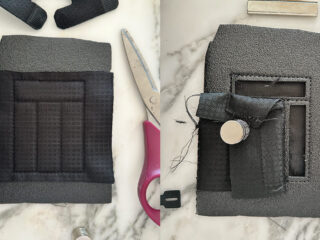
A useful soft goods product brief explains who the product is for, what it needs to accomplish, how it will be used, and the commercial and technical constraints around it. Include your current work, development budget, intended production volume, and unresolved questions. You do not need to choose every fabric, closure, or construction method before contacting a development partner.
One of the most valuable things a founder can bring to an initial conversation is a clear explanation of the problem. It might be supported by customer interviews, a rough mock-up, or photographs of an existing workaround.
A polished rendering can help communicate an idea, but it cannot explain which decisions are essential and which are still open. Your brief should make that distinction visible.
Here is how to prepare a brief that supports a useful development conversation without trying to finish the design before the work begins.
1. Describe the user and the situation
Start with the person using the product and the task they are trying to complete.
For a bag, explain what it carries, where it travels, and how the contents need to be accessed. For a wearable, describe where it sits on the body, the movements involved, and how long it will be worn. For a removable cover, explain what it encloses, who removes it, and why.
Include the current problem. Does an existing product shift during movement? Is it difficult to put on? Does a cover take too long to remove for cleaning? Do users improvise a solution because suitable products are unavailable?
If the buyer, wearer, and person responsible for cleaning are different people, identify each of them. Their needs may affect different parts of the design.
Share the evidence behind your description. A customer observation, your own experience, and an assumption about a future market are all useful inputs, but they are not interchangeable.
2. Separate essential outcomes from proposed solutions
Founders often have strong ideas about materials, shapes, and mechanisms. Include them, along with the reason behind each choice.
The development partner needs to know whether a detail is fixed or simply the best idea considered so far.
| If your draft says… | Add this context… |
|---|---|
| It must use a magnetic closure. | Why that closure is preferred, what the user needs to do, and whether other approaches may be explored. |
| It needs premium fabric. | The intended feel, appearance, use environment, care requirements, and relevant reference products. |
| It must be comfortable. | Who will wear it, where it contacts the body, expected wear duration, movements, and current discomfort. |
| It must be inexpensive to produce. | Target selling price, intended sales channel, production quantity, and any manufacturing cost target with its assumptions. |
Label items as requirements, preferences, or assumptions. Rank the requirements so the team understands what matters most when goals compete.
For example, a compact folded size may be more important than a particular silhouette. Easy removal may matter more than hiding every fastener. That information gives the development partner room to propose a better approach.
3. Explain what performance means in use
Broad goals become more useful when connected to a situation the team can evaluate.
Instead of only saying that a bag should be durable, describe the contents, expected carried weight, handling conditions, and how frequently it will be used. Instead of only requesting a washable cover, explain which parts must be removable and the intended cleaning routine.
For body-worn products, share the intended fit range and whether the product is worn over clothing or against the skin. For a padded product, describe the support it should provide and the movement it should allow.
Record known dimensions, weights, and limits with units. If a number is provisional, say so. Where a test method or acceptance threshold has not been established, mark it as something to define during development.
You do not need to invent technical specifications to make the brief look complete. A clearly identified unknown is more useful than an unsupported number.
4. Identify hardware and other fixed interfaces
If the product incorporates electronics, a frame, a rigid housing, or an existing component, include the information needed to understand that interface.
Useful inputs may include:
- Current component dimensions, mass, and drawing or CAD revision.
- Mounting locations and areas that may or may not change.
- Access needed for controls, connectors, batteries, or maintenance.
- Cable paths, bend limits, ventilation needs, or other constraints supplied by the relevant engineering team.
- How components will be installed, removed, and separated for cleaning.
- Who owns each component and approves changes to it.
Distinguish fixed production hardware from an early engineering prototype. If the housing is likely to change, the textile design needs to account for that dependency.
Include physical samples when available and appropriate. A drawing communicates geometry; handling the assembly can reveal access and movement questions that need further discussion.
For more on these relationships, see Hard Goods vs. Soft Goods Integration: A Guide for Hardware Startups.
5. Show what exists—and what it has demonstrated
Organize your existing material into a small, labeled reference set. This might include sketches, renders, mock-ups, user feedback, component information, and previous sample photographs.
Explain the purpose and status of each item.
A rendering might show the preferred appearance. A handmade mock-up might demonstrate how the product is put on. A supplier sample might show a possible construction, while leaving fit or cleaning unresolved.
For previous prototypes, summarize what you learned: what worked, what did not, and under what conditions you evaluated it. If you changed the design afterward, identify the current version.
Reference products are also helpful when accompanied by a reason. “I like the accessible opening on this bag” is more actionable than a folder of unrelated product photographs. Describe the function or quality you want to learn from, rather than asking for a copy.
6. Share the commercial boundaries
A development partner needs enough commercial context to recommend a realistic scope.
Separate the budget for professional design and development from allowances for factory samples, tooling, specialist work, testing, shipping, and production inventory. If you have one total budget, explain that it must cover all of those activities.
State what funding is available now and what depends on a later investment or campaign. This helps establish a sensible first phase and the decision needed before another commitment.
Include your intended first production quantity, number of sizes and colors, selling price, and sales channel. Identify whether these are supported by demand or are planning assumptions.
A target manufacturing cost is useful, but it is not a supplier quotation. Clarify what the target includes and which design and quantity assumptions support it. An unresolved concept may need development before a manufacturer can provide a meaningful production quote.
If you are still organizing the investment, How Much Should You Budget for Soft Goods Product Development? provides a separate planning guide.
7. Define the next decision and the people involved
“Ready to launch” leaves a lot of room for interpretation.
Explain what you need to decide next. You might need to compare product configurations, investigate a difficult attachment, assess a revised fit approach, or prepare an established design for factory sampling.
Then identify the deliverable needed to support that decision. A visual concept, a functional mock-up, a technical package, and an approved production sample serve different purposes.
Share desired dates and explain why they matter. Distinguish an investor presentation from a user trial or inventory delivery date. Name the person responsible for consolidating feedback and approving the direction.
Also flag intended markets, special use conditions, and any planned performance or medical claims. Identify the specialists already involved and any responsibilities that still need an owner. Relevant engineering, testing, or regulatory evaluation should be scoped with qualified professionals; a design brief does not establish compliance or validate a claim.
If the central question is whether a proposed approach is practical, the appropriate starting point may be a soft goods feasibility phase.
A simple product brief template
Use these headings as a working document. Short, specific answers are more useful than long descriptions. Write “unknown” where necessary and identify who can help resolve it.
| Brief section | What to record |
|---|---|
| Project and version | Working name, date, brief owner, and revision. |
| User and problem | Intended user, current workaround, problem, and supporting observations. |
| Use scenario | Where, when, and how the product is used; duration, movement, and care. |
| Essential outcomes | Ranked requirements and how success could be evaluated. |
| Preferences and assumptions | Desired solutions or aesthetics that remain open to review. |
| Physical constraints | Fit range, contents, loads, hardware, dimensions, and fixed interfaces. |
| Current work | Reference files, prototypes, revision status, findings, and limitations. |
| Commercial plan | Development budget, separate expenses, quantity, variants, selling price, and funding status. |
| Immediate scope | Next decision, requested support, deliverables, and exclusions to discuss. |
| People and timing | Decision-maker, collaborators, specialist responsibilities, dates, and dependencies. |
| Open questions | Unresolved issues and which need attention first. |
Keep the main brief easy to read. Put supporting drawings, research, and detailed specifications in clearly named attachments rather than burying the essential information in them.
Example: a brief that leaves room for development
Consider a hypothetical team developing a textile carrier for a handheld inspection device. This is an illustrative example, not a studioFAR client case.
Their initial request might be: “We need a neoprene sleeve with a buckle.”
A more useful brief would explain that technicians need to carry the device during walking inspections and remove it repeatedly for readings. It would include the device dimensions and mass, intended clothing layers, existing attachment problems, and access needed for controls.
The team might state that the housing cannot change, but the carrying position and textile construction can. The proposed neoprene sleeve would be labeled as an initial idea, while the essential requirements would concern retention, access, and usability.
The first development question would then be clear: which carrying arrangement best supports that workflow? The team and development partner could agree on the comparisons and physical trials needed to answer it before specifying the final assembly.
What your development partner should help resolve
You should not need a completed design or manufacturing package to ask for development help.
Your role is to communicate the problem, the evidence, and the business constraints honestly. The development partner's role is to review that information, question assumptions, identify missing inputs, and propose a defined scope for moving forward.
After the initial discussion, update the brief to reflect agreed decisions. Record changes to requirements and consider their effect on scope, cost, and timing before carrying them into the next sample.
The brief is the starting point for alignment. The proposal or statement of work should separately define the agreed services, deliverables, fees, responsibilities, and exclusions.
Discuss your brief with studioFAR
studioFAR is a US-based soft goods product development consultancy working with founders, startups, and product teams on wearable, sewn, and hardware-integrated products.
If you have a defined problem and are planning to invest in development, share your project with studioFAR. Include your current stage, key constraints, available budget, and the questions you need help resolving. Those inputs support a more useful conversation about the right starting scope.
Frequently asked questions
Do I need a tech pack before contacting a soft goods development partner?
No. A brief communicates the problem and development objectives. A tech pack documents the design for sampling or manufacturing as the design becomes defined. If you already have one, share it with its revision date and identify anything that remains unresolved.
How long should a soft goods product brief be?
Aim for a main document that can be understood in a few minutes. A few focused pages may be enough, with drawings and research attached separately. Technical complexity may require more supporting detail; the priority is clarity rather than a fixed page count.
What if I do not know which fabric or manufacturing process to use?
Describe the behavior, appearance, care needs, and constraints the product must satisfy. Material selection and construction development can form part of the engagement. Clearly label any suggested fabric or process as a preference unless it is a genuine fixed requirement.
Should I include my budget in the brief?
Yes. State the available development investment and explain whether sample costs, testing, tooling, and production are separate. A budget range helps the partner propose an appropriate scope and identify where the intended product may exceed available resources.
Can I use AI-generated images in a product brief?
Yes, as visual references. Label them as concepts and explain which aspects matter. They do not establish that the shown construction, proportions, or mechanisms will work. Include functional requirements and unresolved questions alongside them.
Can a development partner quote manufacturing costs from my brief?
The brief may support an early discussion of cost drivers and missing information. A dependable supplier quote usually needs a sufficiently defined design, materials, quantities, and manufacturing requirements. Keep preliminary estimates and assumptions separate from confirmed quotations.