Before building wearable prototypes for a clinical pilot, define what the pilot needs to learn, which performance requirements are established, what remains uncertain, who will wear the product, and how it will be used. The founder, clinical team, engineering team, and product development partner should agree on those requirements before samples are commissioned.
You do not need every detail of the commercial product finalized. You do need enough clarity to build prototypes that support the evaluation you intend to conduct.
An early prototype may already demonstrate a promising mechanism. The next challenge is translating that mechanism into something people can put on, adjust, move in, and use within a real setting.
That transition is where soft goods development becomes an important part of the product.
Start with what the pilot needs to learn
“Build ten prototypes” describes a quantity. It leaves the purpose of those prototypes undefined.
Is the team investigating product performance? Exploring how the wearable fits different bodies? Learning whether clinicians can introduce it into their workflow? Evaluating how easily users can put it on and adjust it?
A pilot may address several questions, but those questions should be explicit. Each one can change what needs to be developed.
If component placement matters to the evaluation, the design needs a way to establish and maintain that placement. If independent use is part of the intended experience, closures and adjustments need to reflect what users can reasonably manage themselves.
The clinical team defines the clinical objectives and evaluation methods. The design team needs to understand what those objectives require of the physical product.
Separate established requirements from open questions
Founders often arrive with a combination of test results, working assumptions, sketches, and ideas for future features. A useful brief makes those categories visible.
For each major requirement, identify whether it is supported by testing, provisionally selected, or still awaiting a decision. Also identify who will resolve it.
For example, an engineering team may still be establishing an acceptable component geometry. Meanwhile, the founder and clinical partners may already know that the product needs to accommodate a particular range of users and be adjusted between sessions.
Some design work can proceed while testing continues. Other decisions may need to wait because they affect the entire construction.
The aim is to make those dependencies visible before committing time and money to samples. A brief can remain a working document while still giving everyone a clear basis for decisions.
Identify the features that could influence performance
With a wearable, material and construction choices can affect how the system behaves.
Fabric stretch may influence component movement. Strap placement can change how a load is supported. A different attachment method may change the relationship between a functional component and the body.
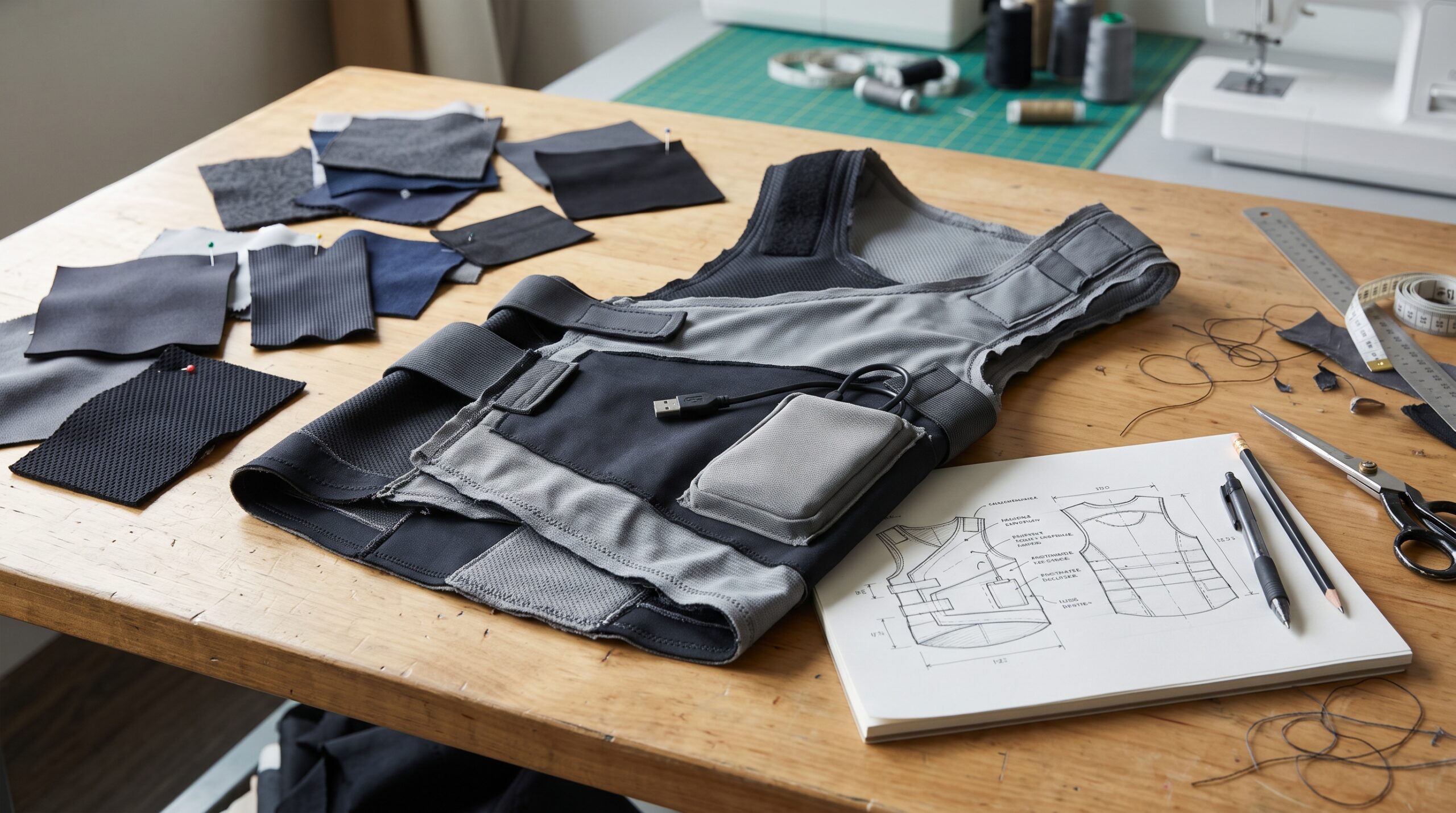
Consider a body-worn sensor mounted to an adjustable textile panel. If the panel shifts during movement, the engineering team may need to assess whether that movement affects the intended measurement. A seemingly small construction change could therefore deserve more attention than its appearance suggests.
Before sampling, identify the characteristics that need to remain controlled for the planned evaluation. Depending on the product, these might include material properties, dimensions, component position, adjustment range, or attachment details.
The engineering and clinical teams should determine which changes require additional assessment. The development partner can help translate those decisions into drawings, material specifications, construction details, and sample review criteria.
Define who will wear it and who will fit it
“Adjustable” is a starting point, not a complete sizing strategy.
The brief should describe the intended users, relevant body measurements, clothing worn underneath the product, expected movement, and whether someone will help with fitting.
A closure that works well when another person adjusts it may be difficult for the wearer to reach. A broad adjustment range may accommodate different circumferences while still placing a functional component incorrectly on shorter or longer torsos.
It is also useful to distinguish sizing from adjustment. Multiple sizes may still be necessary even when each size has adjustable straps.
The practical question is whether the intended users can achieve the required fit without compromising the product’s function or usability.
Describe the setting and the routine around the product
A wearable becomes part of a sequence of actions: retrieving it, preparing it, fitting it, using it, removing it, and preparing it for the next session.
Those actions belong in the development brief.
For shared clinic equipment, ask the clinical partners about cleaning procedures, drying, storage, handling, and how users will be fitted. The appropriate team should establish the cleaning requirements; material and construction choices can then be evaluated against them.
For home use, consider the amount of preparation required, whether instructions are understandable, and how loose parts or adjustments will be managed.
These details can reveal design requirements that are absent from an attractive rendering. They also help the team decide which features need attention before the pilot and which can be developed later.
Decide how closely the prototype must represent the future product
A prototype can look unfinished and still be useful. It can also look polished while leaving important functional questions unresolved.
The required level of finish should follow the purpose of the evaluation.
Color or branding may remain open if they are irrelevant to the planned questions. Material behavior, component placement, or fit may require much tighter control. Even apparently cosmetic features should be considered if the pilot is evaluating user acceptance.
An off-the-shelf garment may be a useful starting point if it supports the necessary fit and component arrangement. Custom development becomes more appropriate when the garment’s construction affects the behavior being evaluated.
Discuss those tradeoffs before choosing a prototype route. A faster build is valuable when it produces useful learning and the team understands its limitations.
Plan the small batch as a defined build
Making several wearable prototypes introduces questions that a single handmade model may not answer.
How many units are required in each size? Are all units intended to be identical? Are there deliberate variations? Will spare units or replacement components be needed?
A documented build specification helps the sample room understand what to produce. Material references, dimensions, attachment methods, and revision identification also help the team connect feedback to the version that was actually used.
Allow time to review an initial sample before authorizing the remaining units. The first build may reveal issues with fit, assembly, access, or sourcing that are easier to correct before the full batch is made.
The schedule should account for design, technical documentation, sourcing, sample review, revisions, and small-batch assembly.
Build the brief together
The founder brings the product vision and commercial priorities. Clinical partners define the use context and evaluation needs. Engineering specialists establish relevant technical requirements and assess performance implications. The soft goods development partner translates those inputs into a wearable architecture and a documented construction approach.
At studioFAR, that work can include fit and ergonomics, material selection, component integration, technical development packages, manufacturing partner coordination, and sample refinement.
Clinical study design, medical efficacy, and regulatory determinations remain with the appropriately qualified specialists. A developed prototype is one part of preparing for a pilot; the responsible team must also determine whether it is suitable for the planned use.
Before commissioning samples, aim to answer:
- What does the pilot need to learn?
- Which requirements are established, and which are still open?
- What product characteristics must remain consistent?
- Who will wear the product, and who will fit it?
- How will it be prepared, used, cleaned, and stored?
- What sizes, quantities, and versions are required?
- Who reviews the prototype and authorizes the next build?
A clear brief gives the development team a shared basis for building something useful—and for understanding what the next round of testing needs to resolve.
Developing a wearable for a clinical pilot? studioFAR is a US-based soft goods product development consultancy helping founders, engineers, and product teams turn technically challenging wearable concepts into practical designs and prototypes. Visit studioFAR to discuss your product and its next development stage.